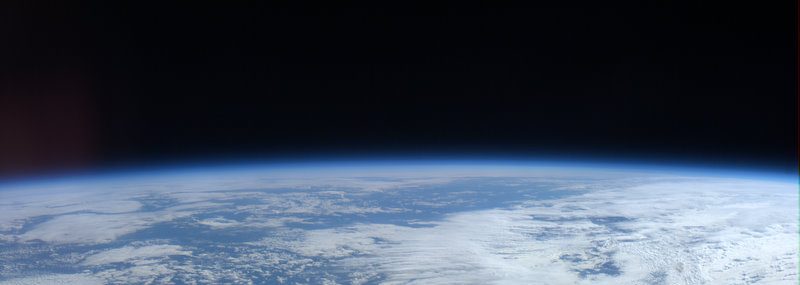
Water, water everywhere?
When you travel around the world you realize that we take a lot for granted here in the United States. Take water fountains, for example. Everywhere you go in the US you can find water fountains; in airports, schools, public parks, almost anywhere you are you can pause and take a drink of fresh, if not cold, water. For many of us living in the US, and other areas of the developed world, the question of acquiring water is not a question at all. Water is so available and so plentiful that it forms part of the background fabric of our lives and we never even think of it. After all it is hard to imagine someone living without water when you have free, abundant, clean water available to you with the turn of a valve. When you travel outside the borders of our country and the developed world, however, you begin to realize what a luxury it is to simply get a free drink of clean water wherever you are. This is not the reality for much of the world. Even though about 71% of the Earth’s surface is covered by water only 3% of that is fresh and fit for human consumption. Water is scarce, seldom clean, and often expensive. Water is a valuable commodity.

We live on a water planet, but unfortunately we cannot use most of it, as is....
It was not until I started traveling extensively that the extent of this problem and the implications of it became apparent. Almost anyone can access the facts on water scarcity and the ramifications of it, but until you see the impact to people lives first hand, the dry numbers turn into a reality that can be understood. (There is a long discussion that can be had about the different impacts of intellectual knowledge and experientially gained knowledge!) For the 884 million people who do not have access to water (see www.water.org ) the acquisition of it, on a daily basis, becomes the central theme of their lives. It was a common sight as I toured through Tanzania and India to see women walking along the side of the road toting various containers, heading to the local water source, be it a well, stream or pond, to get water for the day; water that may not, in the end, be very clean but their only choice. They do this day after day after day. The pursuit of a daily water supply defines their lives. In some areas of the world obtaining water can be dangerous as it may require women to walk alone through war zones or tension filled areas. It is hard to be focussed on school work or earning a living when most of your day is spent obtaining one of the of basic necessities of life. I could not help thinking, on my first exposure to this time-intensive, demanding lifestyle- driven by the pursuit of water- what my life would have been like had I been born in one of these countries. Would I have been able to go to school, get the education I did, get the job I have which allows me to have a lifestyle that enables me to travel the way I do? Probably not.
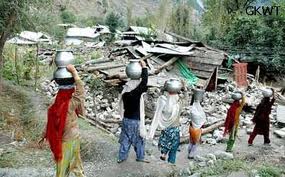
Every day in many parts of the world women spend most of their day fetching and carrying water.
While traveling I have to adjust my lifestyle and expectations regarding water. At work every day I carry around a 64 ounce container filled with water. If I happen to get through it, which I try to do knowing the importance of staying hydrated in a hot climate (Houston), I know I merely have to stop by a water fountain to get more if I need it. When I go to other countries I try to carry around a lot of water with me as well but I have to remember to buy it. Depending on the country I can keep the bottle and refill the it from the tap or I have to throw the empty bottle out and buy another, an imperfect solution that adds to the local trash problem. In some places, such as when I was in Tanzania and remote areas of Russia, for example, I had to brush my teeth using bottled water because the tap water was not potable, not even for the locals. You could shower with it but not consume it. In other places, such as Peru, I could brush my teeth with tap water but not drink it. In all of these places I had to devote time and energy to water needs that in the US was never required.
Even when water is available it not always is clean. In 1998, living in Moscow for the first time, I had to get used to a whole new experience with showers. Sometimes when I ran the shower the water would start out brown and then eventually turn clear, or in some cases, it just stayed brown. At that point the decision had to be made-take a shower today or not. Even something as simple as the availability of hot water is not guaranteed, the way it is here in the US. Moscow has a central heating system for the city, based on steam, which is tied into the hot water delivery as well. In the US each house or apartment or building has hot water heaters which heat and store large quantities of hot water for use. This is not the necessarily the case in Russia and so when the main heating system goes down for maintenance, as it does every summer, the access to hot water disappears. During the summer no matter where you live in Moscow there will be a period somewhere between 2-4 weeks where you may not have access to hot water because the pipes are being worked on in your district. This was a big surprise to me my first summer in Russia. Our workaround to this problem was to install small hot water heaters and tanks so that when the main system went down a small local reservoir was available for a really quick shower. (I have more than one funny story about running out of hot water at the worse possible time…) Most natives, however, simply took sporadic sponge baths or heated small batches of water on the stove when needed for bathing.
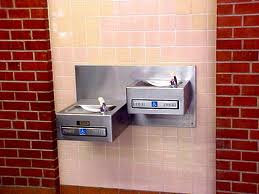
A welcome sight when I return from international trips. When I see public water fountains I know I am home.
Whenever I get back to the US after a trip abroad I really know I am home when I pass my first water fountain and I can take a long, cold, free drink without worrying about the quality of the water. Drinking from the first water fountain I encounter after arriving in the States has become something of a ritual for me as a way to reflect on how fortunate I am and remember to not take things for granted. Adventures are truly broadening and changes your perspective on things!!!


Hey there, You have performed an excellent job. I will certainly digg it and in my view suggest to my friends. I am confident they’ll be benefited from this site.
This is the proper blog for anybody who desires to find out about this topic. You realize so much its virtually hard to argue with you (not that I truly would want…HaHa). You positively put a new spin on a topic thats been written about for years. Great stuff, simply nice!