Inca Trail – Day 4 (Machu Picchu)

Having made the decision the day before that we were going to get up early and get in line to beat the crowds we were mentally braced for the 3:20am wake up call, but nonetheless it seemed to come early. As we moved about and packed up we heard sounds from the campsite next door so we were not the only ones getting an early start. It was dark, of course, but the clouds were not completely covering the sky and a few stars were visible. We had a quick, but again delicious, breakfast and raced over to the nearby checkpoint. When we got there, at 4:05am, we were not the first, but actually the third group. We were happy because 1) the two groups ahead of us were small so there were not that many people in front of us, and 2) if it decided to start raining we were under a roof and could avoid standing around in the rain. We sat down on the bench and proceeded to wait, talking and joking, until the 5:30am start time when the checkpoint opened. As we sat there it got more and more crowded as other groups trickled in one by one. The noise level grew as they came and soon there were packs and people strewn about with as many people as possible trying to get under the roof of the shelter but, thankfully, although it remained cloudy, it never rained.

The view from the Sun Gate when we arrived. Unfortunately Machu Picchu was in a cloud and not visible yet.
The sky started lightening about the time the checkpoint opened. The guides were gathered at the window sorting things out with the rangers and before I knew it we were passed through and on our way to the Sun Gate. After about 10 minutes of walking it was light enough that I could turn off my headlamp. The goal was to get to the Sun Gate and see the sunrise over Machu Picchu (weather permitting). The hike to the Sun Gate, at the brisk pace that we set, was between 30-45 minutes. I looked back a few times to see a long line of people snaking behind us. It was going to be a bit crowded once we got there. The path to the Sun Gate went both up and down and we found ourselves, again, on steps. The very last set of steps were so steep, as a matter of fact, that I almost found myself crawling up them as you would a ladder. One last mental barrier before the wonders of Machu Picchu would be revealed!

The mist slowly lifted allowing us partial glimpses of the ruin. Luckily the day grew clear and sunny later!
When we arrived at the Sun Gate there were only about 15 or so people there ahead of us (the two groups who went through first) so it was not too crowded, yet. Unfortunately the clouds and mist were still low against the mountain and even though we knew Machu Picchu was spread out below us we could not see anything. We took a quick photo and decided to press on to the site. In the short amount of time it took us to get into a group and get the photo about 20 or so more people had arrived. We quickly gathered up our packs and headed down the trail for the ruins, hoping that eventually the sun would come out. Indeed as we were hiking along the mist started to clear teasing us with glimpses of part of the construction. The whole site was not yet visible but as we got lower more and more of it was revealed. It was kind of like opening a present a Christmas- as you tear the paper you get small glimpses of the what is inside but have no idea until all of the paper is off. I glanced back at the Sun Gate and it was still thickly cloaked by clouds so our decision to move lower right away was going to pay off.

The residential section of Machu Picchu. According to Erick it is broken into three sections, residential, agricultural, and religious.
From the Sun Gate you enter Machu Picchu at the top of the site. We reached the famous rock where the classic photos are taken but still a view of the total site remained elusive although the little bit we could see was impressive enough. Erick took us by a few interesting places on the way down to the front entrance where we had to check in (and there were first class toilets located there!). This was probably my favorite part of the day that we spent at Machu Picchu. The clouds and mist made it a bit mysterious and at 8:00am or so we practically had the whole place to ourselves. (It would get incredibly more crowded later in the day when the trains arrived carrying the day-trippers.)
We slowly made our way down to the gate, checked our packs, used the toilets, had our tickets stamped, then re-entered the site for a two hour tour with Erick after which we would have free time for several hours. As we were taking care of all of this business the sun was continuing to burn off the clouds and by the time we started our guided tour the whole site was visible, the surrounding mountains were visible, and it was starting to get hot. The Sun Gate remained obscured for another two hours or so though. Everyone has seen pictures of Machu Picchu (and if you haven’t simply type “machu picchu pictures into a browser and you will find some) so I won’t bother to describe it but, quite frankly, pictures cannot do justice to the impression you get when you see it in person. There, spread out below you on an incredibly steep slope as if it is about to fall off the mountain, is a small city precisely engineered. The stone work is absolutely amazing. I had seen examples of Inca craftsmanship in some of the walls in Cusco, but here was a city in the middle of nowhere, literally, built with the same painstaking attention to detail with rudimentary tools. Really, as I said before, the Inca’s were amazing builders.

A picture of what the roofs would have looked like. Woven from a local grass into a tight mat, they were tied down by the small round pegs you see coming out of the wall. Several roofs were reconstructed to illustrate the technique and look.
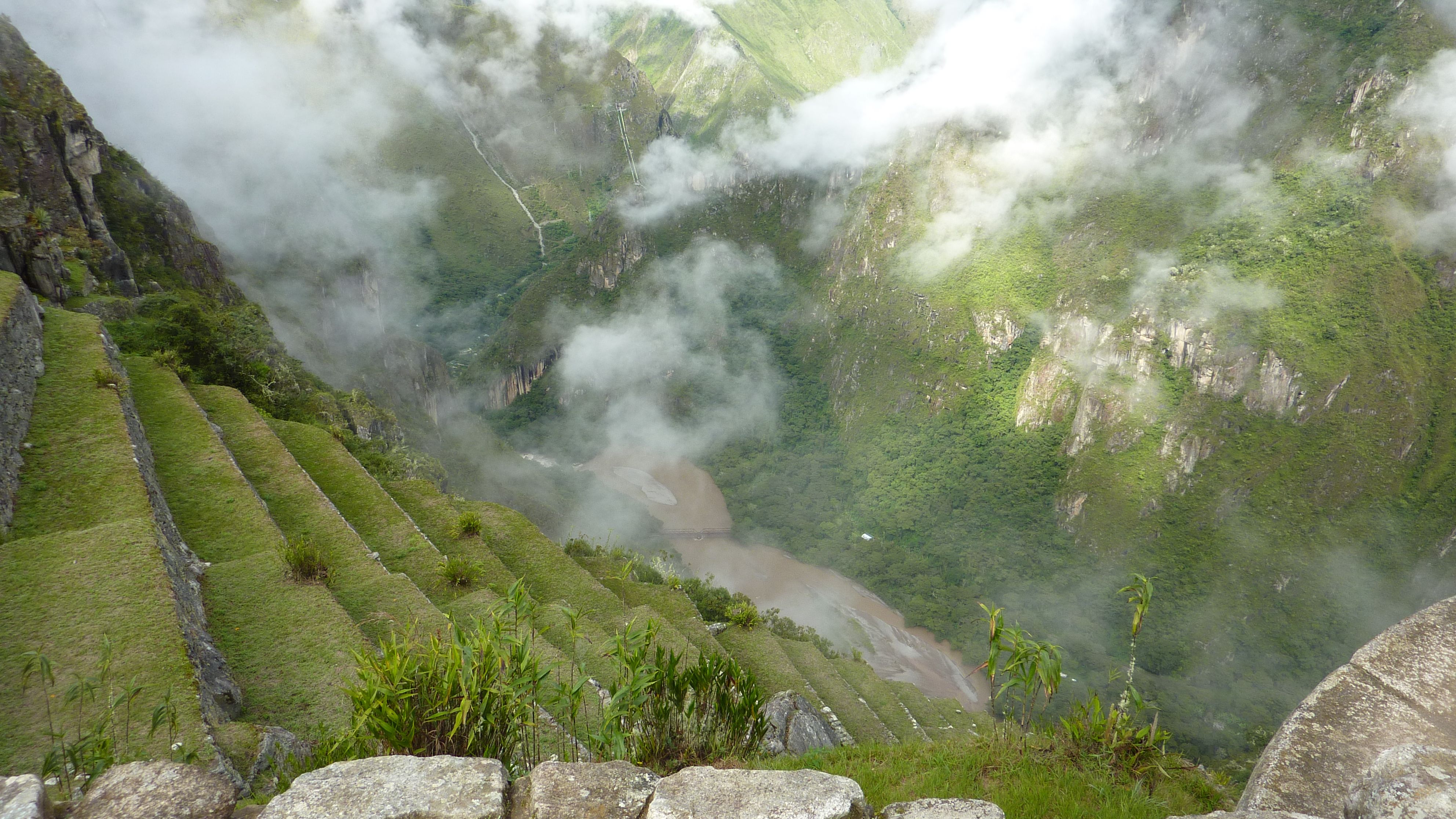
Erick took us around the site and explained some of the highlights, the temples and their purpose, many of which seemed to have mechanisms to track the summer and winter solstice. Like Winay Wayna there were a series of cascading fountains, 16 in all at Machu Picchu, which provided water to the various areas of the city. Also like Winay Wayna, there were stairs, and steep ones at that, all over the place and we found ourselves, again, constantly going up and down as we moved around the city. Machu Picchu is surrounded on all sides by the Urubamba river so it has some natural fortifications. The “front” side of the city is the one most often seen in the photos. On the “back” side there is a quarry where the Incas mined their construction material. In addition part of the city is built directly out of bedrock and they simply incorporated those existing shapes into their designs. A small number of homes had restored roofs, made out of plant material, in order to show what the city might have looked like when lived in. Erick gave us so much information about the site, the buildings, the lifestyle that I cannot repeat it here-you will just need to go yourself. It will be worth the trip. Not only is the city itself fascinating but the surrounding scenery is worth it just by itself.
After our guided tour we had some free time to wander around on our own. We agreed to meet for lunch at 1:00pm in Aguas Calientes, the town at the base of the mountain that Machu Picchu sits on. This is also the port of entry for everyone arriving by train for a day visit to the ruin. A bus service provides transportation from the train station in town up to the gates of Machu Picchu. We had bus tickets to get to Aguas Calientes as well as train tickets for the ride home later in the day as part of our package.

Listening to Erick as he relays the history and stories of the ruin. He was a great guide!!!
Everyone had different plans for the free time but we all agreed to first go together to the special “rock” to get the classic picture with Machu PIcchu in the background. From there we split up. As the Sun Gate, finally, had cleared up, the Australian guys decided to hike back up there to see the view. Everyone else just wandered around on their own poking around the city. I was tired of steps and really just wanted to sit and take it all in so I sat on a big rock near where we had taken our group photo and watched the world go by. From my perch I had a great view of the whole ruin and the surrounding mountains. The clouds were still darting in and amongst the surrounding peaks so the scene before me changed regularly. I also got a kick out of watching the crowds go by, and by now, it was crowded. Sitting where I was I could see tiny people moving around down below me as they explored the site. It is believed that between 800-1000 people lived in the city and using the tourists below as substitutes I could get an idea of what the city looked like when alive with people occupying it.

An example of Inca stonework. The bedrock of the mountain was incorporated into the Temple of the Sun and Temple of the Earth and the gaps filled in with custom cut precisely fit stones. Notice how there are no gaps anywhere. This same type of intricate construction can be seen in Cusco and all over the Sacred Valley. The labor involved must have been tremendous!
I sat there for about an hour and a half before it was time to climb down to the front gate, find the bus to Aguas Calientes, and head to lunch. It was time to go anyway as I was getting fairly sunburned, a nice change from the rain. As I headed down the path to the gate I passed yet more tourists heading up the stairs to enter the ruins. Some of them were struggling and I felt for them because they had not even begun to experience the stairs they would have to conquer. The entrance was busy with people coming and going but I easily found the bus and settled in for the drive down the mountain. That was another great experience because the road was packed dirt (what do they do during heavy rains??) and barely wide enough for one bus. As we descended on the steep narrow road, which at least had switchbacks, we encountered five busses heading up. At each encounter one of the busses would have to back up into the carved out parking spots, designed just for the purpose of allowing passing traffic. I was glad I was heading down if all of those people were going up- the site was going to get even more crowded.
Aguas Calientes seemed to have been created just for tourists coming and going to Machu PIcchu. It was small enough that cars were not needed. Indeed I am not sure they even had any. Main street was the train tracks which may be the only means of transport to and from the city, I am not sure. There were plenty of hotels, hostels, and restaurants in town and of course, a craft market. The prices were higher here in Cusco but not too obnoxious. We all gathered for lunch and just enjoyed each other’s company. We had about an hour to explore the town before boarding the train home. The train, which winds along in the valley next to the Urubamba river, took us as far as Ollantaytambo, where we switched to bus for the ride back to Cusco. In the dry season you can take the train all the way to Cusco but in the rainy season it stops in Ollantaytambo because of the fear of landslides, Landslides are common in the hills in rainy season and in back in February I would hear of them often.
We finally arrived back to Cusco about 9pm. Reluctant to say good-bye to each other we all agreed to meet for dinner the following night. But for tonight– I went home and straight to bed. It had been a long day; a long four days and I was tired, but it was an excellent trip and a wonderful experience!!!!


Congratulations! Fantastic descriptions of your trek. I could follow your every step. Thanks for sharing it. Seems like the icing to your adventures in Peru!
Thanks for sharing. This is a dream of mine. Congrats on making the trek.
How could you bear to leave so soon, after all that effort of getting there:) Thanks for sharing – particularly that magnificent shot of the stonework melding with the natural rock features – makes you think, eh?
I have to ‘fess up Sandy: I’ve been wanting to go to Machu Picchu since 1972, when I first set out from Australia. I even immigrated to Canada (you could do those things easily, those days) so I could save money to get there – England being impossible. I never even made it to Mexico:) Somehow I got sidetracked by life (and love) and Europe, then later Asia, seemed to absorb all my attention. Just last year, I wondered if I’d missed my chance (not because of age, necessarily, but the effects of an accident), and I think your detailed descriptions help answer that question for me. Thank you.
Warning: don’t leave the hard things till later …
Great pics & story. The work done at those sites is nothing short of amazing. Thanks for sharing your trip!
I am so jealous! This is something I one day hope to have the money to do, but for now I will just listen to all the glory of it in University. Have a great time!
This is a wonderful and evocative review of a visit to Machu Picchu, and we love your photographs!
Sandy – absolutely beautiful.
R
Very nice account of the Trek. I like the pictures!
Everyone: Thanks for the comments and I am glad you like the pictures. I wish they could do justice to the grandeur of the scenery!! So green and so dramatic, especially with the clouds darting in and out of the peaks and valleys.
Sandy~ As I read the narration of your journey on the Inca Trail, I felt like I was there with you. Very inspiring, time to make a Bucket List. Thank you. ~ Franny
This is so inspiring. Machu Pichu and the surrounding area is my ultimate goal in my world of travel. If only we could drag it a bit closer to Australia to make it easier and cheaper to get there. But, as they say, life, nor travel it seems, is meant to be easy. Thank you for sharing.
Oh, your pictures bring back some great memories. Thanks for them.
Wow, awesome weblog layout! How lengthy have you ever been running a blog for? you make running a blog look easy. The total look of your web site is wonderful, let alone the content material!