
Lima (Part 2)
I got a late start on Saturday, but then again what defines early or late when you are on vacation? I decided to simply meander around the Miraflores district on Saturday and not head back to the city center. First on the list of things to do was a visit to an adobe pyramid, the Huaca Pucllana, which was located on the edge of San Isidor. It is a pre-Incan pyramid dating back to the Lima culture that is located smack in the middle of present day Lima. The city had grown up around it and was encroaching on the grounds when it was decreed a heritage site and protected. (For more information: http://www.limaeasy.com/culture/huaca_pucllana.php and http://en.wikipedia.org/wiki/Huaca_Pucllana ).

The hotel was located right on the edge of a grove of olive trees and this was the start of my Saturday walk.
I arrived in time to take the guided tour in English. The grounds are large and in various states of repair. Many of the walls are original although some of the higher portions of the pyramid have been reduced to rubble over the centuries (and are currently in a state of restoration). We had a knowledgeable guide and the tour was very interesting. He explained the existence of some of the original walls as due to the type of construction, the “bookshelf” technique, utilized. In this type of construction the mud bricks were stacked like books on a shelf. Such construction left spaces in between the bricks which damped some of the vibrations caused by earthquakes. Thus the walls were able to withstand numerous earthquakes because they had enough inherent flexibility to move without tipping over.
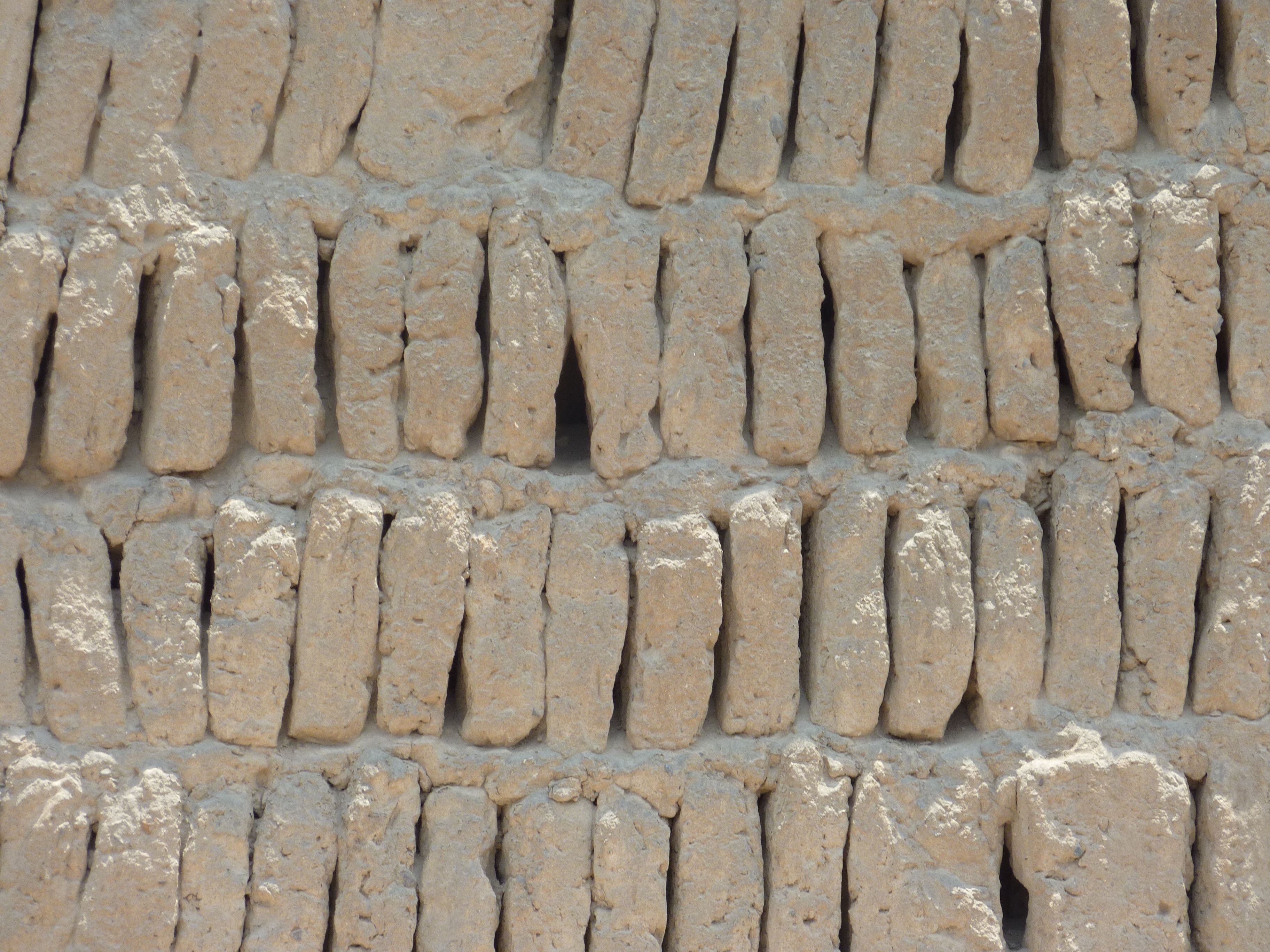
An example of the "bookshelf" technique. This is how all the walls of the pyramid were built. Many of the original walls are still standing, having survived numerous earthquakes.
A great view of Lima was available at the top of the pyramid, at least where it was not blocked by buildings. Imagining the view without a modern city surrounding it, it was easy to see the advantage of such a massive structure for keeping track of what was occurring in the area. The complex was massive with different parts speculated to serve different ceremonial functions. At the end of the tour was a display of some of the fauna and flora and a small selection of animals indigenous to the area. The vegetables and plants were no surprise, having been in Peru now for five weeks I was fairly familiar with the local foods. What was interesting, though, was the presence of hairless Peruvian dogs. i have never heard of them before and they were, indeed, hairless dogs, except for a lonely tuft on their heads. According to our guide, the dogs have a slightly higher body temperature and as such were used in healing and medicine in the ancient days. The dogs were friendly but looked rather unusual.
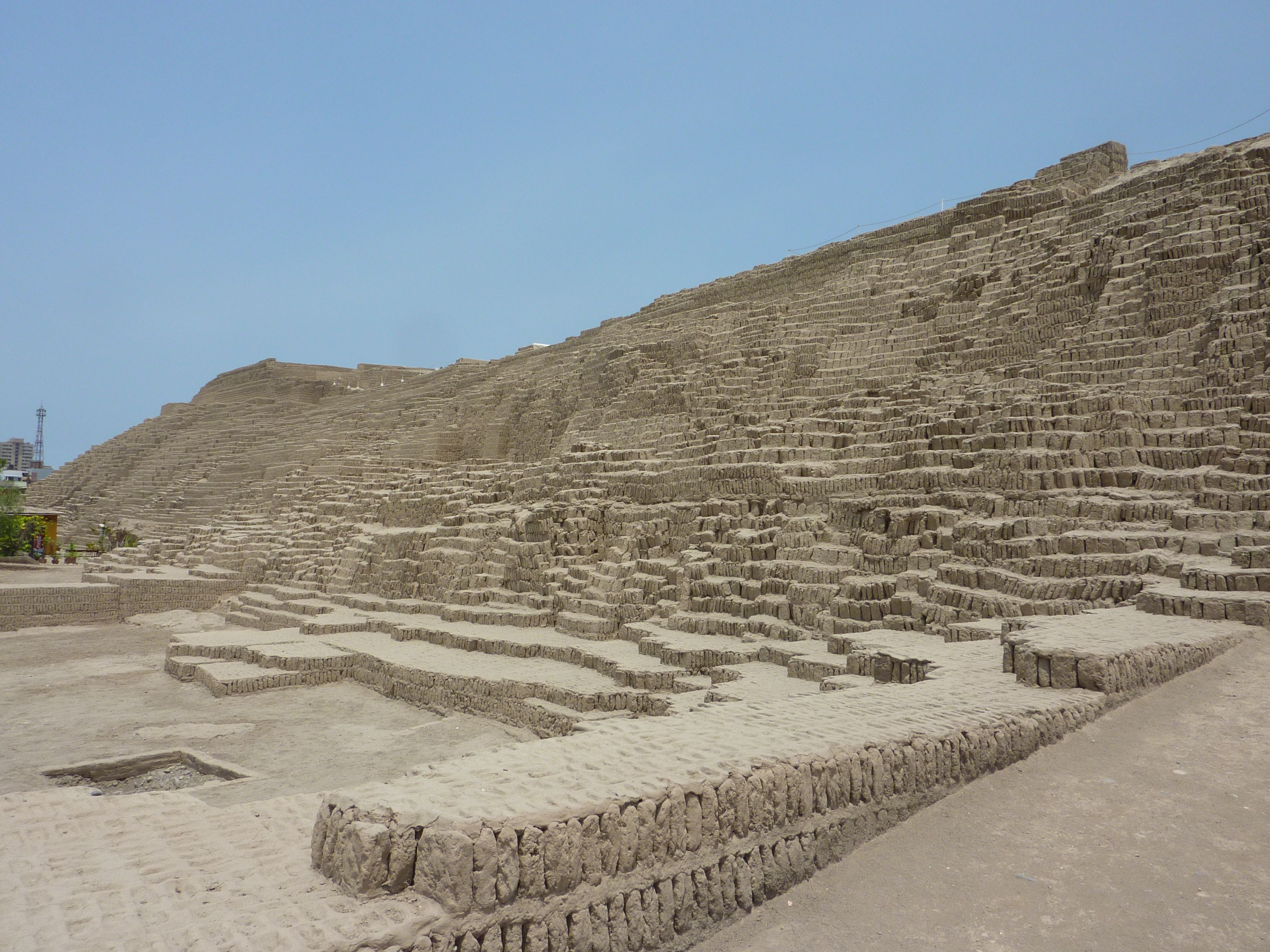
The adobe pyramid still standing, dating back to the Lima civilization. The city surrounds it but it is now protected and an active archaeological site.
After finishing the tour I decided to continue my tour of Miraflores and headed down towards what was described as the “Indian market”. Suspecting this was a big craft market I decided to go check it out. It turns out that the Inca or Indian market in Lima is huge and actually extends across several buildings and city blocks. For such a huge market it was noticeably lacking in shoppers. I asked one of the vendors where all the people were and was told that June and July were the busiest months. It is not crowed this time of year so if you want to visit Lima without crowds, March seems to be the month to do it (but be prepared for the heat!). I spent some time walking around half-heartedly souvenir shopping but after a while everything started to look the same so I simply shut down.

A Peruvian hairless dog. Very weird looking, I think.
After reaching saturation I continued heading west through Miraflores towards the ocean, my final destination for the day. i passed another park with some artists displaying their works, more areas with restaurants and hostels, and eventually reached the cliffs. As I emerged from the streets to the green park along the cliffs I saw a huge group of mainly teen-age girls gathered at the curb in the park right in front of a Marriott hotel. They were all simply standing there in a big group, some with signs. I walked by in bewilderment trying to figure out what was going on and eventually asked someone. Apparently there was a popular musical group from Japan (I never got their name) staying in the hotel and these fans had gathered outside of it trying to gain a glimpse of them. I walked past the crowd and went to the edge of the park and looked down to see a shopping center built into the side of the cliff. It was an open air mall with tons of stores and restaurants. I decided to go investigate and perhaps find a place for lunch/dinner. It turns out that one of the restaurants that was recommended to me, Mangos, was located here so I ate there. It had seating on the edge of the cliff overlooking the ocean so the setting was perfect.

Clouds rolling in.
As I sat and relaxed and had my meal clouds were slowly rolling in from the ocean. Slowly the city disappeared around me and soon I found myself sitting in a fog bank. The temperature remained warm although the sun, too, was obscured. After finishing dinner I decided to leisurely start strolling back to the hotel. I climbed back up to the top of the cliff and saw that the group of fans was still there. The band members were apparently making sporadic appearances on the balcony accompanied by the excited screams of few hundred teen-age girls. It was quite diverting and I was not the only passer-by who stopped to watch. The rest of the walk home was uneventful except for the delicious gelatto that I got about half way back. Once again, even though it was getting dark there were many people on the street and I felt secure in walking all the way back. Lima seems to be a nice city to walk around in.
In general Lima was very hot and I did not know this before, but according to the guide at the pyramid, Lima is the second largest desert city in the world (behind Cairo). Apparently they get less than an inch or two of rain a year in the city. I had ample opportunity while walking around to observe the traffic and it was was pretty horrendous. At intersections grid-lock happened frequently and horns were honking all around. It is funny but while living here in Peru I have identified different horn sounds ranging from “hey, I am here” to “looking for a taxi?”, to “get out of my way” to “don’t cut in front of me”. In the US the only horns I can recall hearing were of the “what do you think you are doing” and “get out of my way” variety. In other parts of the world horns apparently have a bigger vocabulary and are an essential part of the driving experience.
There are other odds and ends that I have had a chance to observe since I have been here so long even though I do not understand why things the way they are. For example, for some reason the police and other public safety related personnel wear lime green gloves. They don’t match anything else on their uniforms and therefore stand out. The other noticeable quirk is that when people talk into their cell phones they remove them from their ear and bring them around to their mouths to directly speak into them. To listen they then return them to the standard position at the ear. It does not matter whether they have an ear phone in or not–everyone moves the phone directly in front of the m to speak. It looks awkward but there must be a good reason for it. Finally, as I have already discussed in “Lima (Part 1)” there is the universal “group-think” when it comes to crossing busy roads. Somehow it all works. I am sure we have similar quirks in the US but since I grew up there they are not noticeable to me. I wonder what they are?
I am back in Cusco now after an uneventful return trip. Next up is the Inca Trail and Machu Pichu mid-week. I am really looking forward to that adventure!


I love your travels.Macchu Picchu is in my “To Go” list.