Lake Titicaca- Part 1
Six of us decided to take a weekend trip to Lake Titicaca this past weekend. Several of the other volunteers had done this trip and recommended it so those of us who had not gone yet got a group together and signed up. The itinerary had us leaving on the overnight bus out of Cusco to Puno, a large city on the northwest coast of the lake and the departure point for most of the lake tours, on Friday night. Promptly at 9:20pm the tour agency picked us up at the house and transported us to the bus station in Cusco. Bus travel is the primary means of transport for the people of Peru- and the tourists, too. Not that many people fly, as it is expensive, nor is it possible to fly to many places in the country. Consequently the bus station was a beehive of activity. The station itself is a large building, with a center open area filled with seats for waiting, surrounded on the outside by row upon row of bus stalls, most of which remain in constant use. Inside the building located around the perimeter walls were counters for the myriad of bus companies that operate in Peru. There were also the usual assortment of vendors selling food and drink and other supplies potentially needed for a long trip (all of the bus trips here are long).

The bus station. Even though it doesn't look it here there were lots of people and activity. Bus is the major means of transport here in Peru.
We had to pay a small S/1.20 tax before boarding our bus and once we had found where to do that and figured out which door to exit we headed out to find the bus. On the curb in the loading zone large coach buses were constantly loading and unloading. Passengers were carrying anything from small backpacks, simply out for a weekend trip as we were, to those with several large suitcase size bags clearly transferring goods from one city to another. The large stowage compartments under the buses filled up fast. The bus that we were booked on turned out to have seats that reclined back into a sleeping position (at least in theory – mine, it turned out, reclined but then slowly returned to an upright position so the whole seven hour bus ride I felt like I was on a see-saw, up, back, up, back, up back…needless to say I did not sleep at all). Most buses were, in addition, double decker. We had assigned seats and soon built our nests in preparation to getting some sleep as we traveled the 241 miles to Puno. We were going to be met when we got there, at 4:30am, and transported to a local hotel for a couple of hours of sleep.

Nesting in my bus seat. Alas no sleep was gained as it continually kept popping up into a seated position- it would not stay reclined for any part of the time. Part of the adventure!
The bus ride was uneventful, but long, especially since I did not sleep much. It rained almost the whole way there and since it was dark I did not get to see much of the countryside so I did not benefit by being awake, unfortunately. We arrived in Puno at a bus station that had the same level of chaotic activity as the one that we left. We easily found the sign with our names on it and got transported to a hotel for a few hours sleep. We arrived about an hour or so late to Puno, something I learned that is not unusual, and so I really did not expect to get any sleep at the hotel at all, nor did I. At 8:00am, after a continental breakfast, we were picked up in a bus and joined the rest of the tour group, who apparently were based out of Puno. The group appeared to be a mixture of French, Belgium, Brazil, and Peruvian nationalities, besides our group which was a mixture of Americans and Canadians. We were taken to the port where we met our guide, Walter, and boarded the boat which would be transporting us to the various places around the lake that were on our itinerary.
Lake Titicaca is the largest, highest lake in the world. The altitude of the lake is somewhere around 12600 feet. If you take a look at the lake on a map you will see it is quite huge (http://en.wikipedia.org/wiki/Lake_Titicaca ). The lake sits on the border between Peru and Bolivia and although it is a very large navigable body of water the whole time we were out and about on the lake I saw very little marine traffic – no regular series of boats moving from island to island, no fisher fleet, no major water transport of goods. Nothing. It was empty of human traffic. At one point I asked Walter about this and he said that all mercantile traffic goes by road around the lake. The people who live on the islands live a fairly isolated existence, as we were to find out during our tour. Even traffic between Peru and Bolivia is apparently via land. The result is a fairly untouched landscape and it is very beautiful.

Approaching one of the floating islands. Everything, including the island was made from a local reed.
Our first stop for the day was at the floating islands. They literally are floating islands although they are typically anchored for set periods of time. A group of indigenous people have been making islands out of the local reeds and living on them for centuries. Apparently the lake level fluctuates greatly between the dry and wet season and so they have learned to build these stable structures to live on, floating up and down with the water level. The reeds are gathered from the marshy areas during the dry season and then woven together to a depth of 5-6 feet. Every year they add another layer of reeds and an island will last for about 20-25 years before the base layer starts to deteriorate at which point they start over again. The island felt weird to walk on since in some areas the surface gives a bit and you can get a a kind of squishy feel where the layers are not yet thick. Their homes, which are single bedroom size, are also made of reeds, as are the traditional boats they move from island to island in. In a nod to modernity they do have solar generators and I saw a satellite dish attached to a church on one island. It is an interesting mixture of old and new. Definitely a unique life-style. Their main business is fishing with the addition of tourism in the last few decades. Each island has about 50-100 people on it.

The boat is made of reed as well.
After visiting the floating islands we headed to our main destination, the island of Amantani for our overnight stay. This island, like many of the surrounding islands, is a small tight-knit community fairly isolated from the mainland, a three hour boat ride away. Amantani has ten communities located on it composed of a total population somewhere between 4000-5000 people. Their main occupation is substinence farming, with some small animal husbandry. This is complemented by tourism as the different communities take turns hosting tourists in their homes during tourist season. The boat ride was pleasant as the weather was warm and sunny. When we arrived at the island the community president was there and in short time we were divided into groups of three or four, and handed over to the custody of our host “mamas”. There being absolutely no motorized transport, or even roads to speak of, on the island, we gathered our things and headed cross country ascending through fields and pastures to the house were we were assigned to stay that evening. After dumping our stuff in our room we were going to be served lunch and then meet up with the larger group again to climb the tallest hill on the mountain to see some Inca ruins.
The house we arrived at was a small two story building with what I have become to recognize as typical Peruvian construction. A small courtyard, open to nature, was located inside a surrounding wall. Several rooms led off of it, including the kitchen. On the second floor, up some narrow, steep stairs was a balcony with two more rooms, one our bedroom, the other the bedroom for the family. The kitchen on the first floor was a small room equipped with a gas stove, a cabinet for dishes, and two tables. One table, which sat three, was for eating, and the other looked like a combination prep table and another place to sit to eat. The floor was packed dirt. Light was provided either by a candle or the one electric bulb (they had solar power) that hung over the prep table.

View from "mama's" house on the island. The boat seen below is the one that brought us to the island. The island was mainly pastures and grass. Not so many trees.
Since it was lunch time, we were invited into the kitchen and once we sat down at the main table lunch was served. Lunch consisted of a bowl of quinoa soup, a very popular and staple part of the diet in this part of the world, followed by rice and potatoes and some fried “squeaky” cheese. It is hard to describe “squeaky” cheese. It is a home-made cheese from cow’s milk and very tasty but many of us tourists have dubbed it “squeaky” cheese because when you chew it, it squeaks. You have to experience it to understand it because I too was confused the first time I heard of it. But after I ate some, it all made sense. It is very tasty, just a bit noisy to eat. To drink we had tea with a local, minty herb in it.
After lunch we gathered our coats, gloves, flashlights, water, cameras, and other necessary equipment and headed up the mountain to the rendezvous spot, the local soccer field. I am not sure how they built it but up the mountain aways at the bottom of the path that leads to the ruins was a small soccer stadium constructed of concrete. Immediately upon seeing it I imagined the local men hiking up and down from the port, time after time after time, with bags of heavy cement on their backs, patiently delivering the materials required to build this small stadium. That is how important soccer is here! We sat and basked in the sun on some of the bench seats while we waited for everyone to arrive. Once we were all gathered we headed further up the mountain to the Inca ruins The hike to the top was not long, only about 30 minutes, but it was straight up, about 700 feet. There was a path, of sorts, that consisted of steps made out of rocks but you had to watch where you were going since it was very uneven and some of the stones were loose.

At the top of the island near the Inca ruins. The view was spectacular and we stayed there for quite some time.
At the top the view was spectacular and we were told that the interior of the ruin was still used as a temple by the island inhabitants on special occasions. We all spread out and just enjoyed the view and the sun. In the distance I could see a thunderstorm gathering momentum and I really enjoyed just sitting there watching the play of sun, clouds, and water. When dusk was approaching and the sun went behind the gathering clouds we decided to head back down the mountain. It was near supper time and the plan for the evening was to eat dinner than gather in the local community building for a dance. We were going to be dressed in local clothing for the event too. By the time we had climbed down from the top of the mountain, down from the stadium, back to our house through the pastures, over the rock walls and around the vegetable crops, we only had about 45 minutes until dinner. We took that time to go to our room and get organized as we had only dropped our stuff off before. Dinner was ready and since it was dark we used flashlights to climb down the stairs to the first floor to the kitchen.

Watching the storm coming in. The changes in lighting were quite dramatic. Pictures can never do it justice!!
Dinner was rice with some vegetables that had been fried and seasoned which turned out to be very tasty. Some new family members were present and introductions, in Spanish, were made again. Also this was the first time we had met one of the men of the household, the brother of one of our hosts. I think one of the women was married to him as well but we never did figure out all of the relationships between the people we met, only that there were three generations present. Two of the women had babies in blankets on their backs in the customary way that babies are carried in the region. The children were small, less than a year old and you could see their faces poking out around the shoulder of their mother’s as they looked at us with wide-eyed curiosity. They looked snug in the blankets but had plenty of freedom of movement as they demonstrated by moving forward and from side to side sending unfounded fears of them falling through us.
After dinner we went back up to our room and shortly thereafter our host mama showed up with the clothing that we would be donning for the evening’s party. The outfit consisted of a white linen blouse decorated with colorful embroidery, a heavy underskirt either in pink, orange or neon green and an outer skirt in red or orange. The skirts were the traditional ones that women wear all over the place in Peru. Even though I had them on over my hiking pants I could feel how warm they were and with the addition of the leg warmers which everyone wears, the outfit would be enough to keep a body warm in this cold climate. The final piece of clothing was a black shawl, also embroidered along the edges in colorful thread, which was for our heads. It too was heavy and did a great job keeping us warm. Once fully outfitted in traditional gear we headed up the mountain, again, to the community building where we found, when we got there, the rest of our group, similarly garbed.
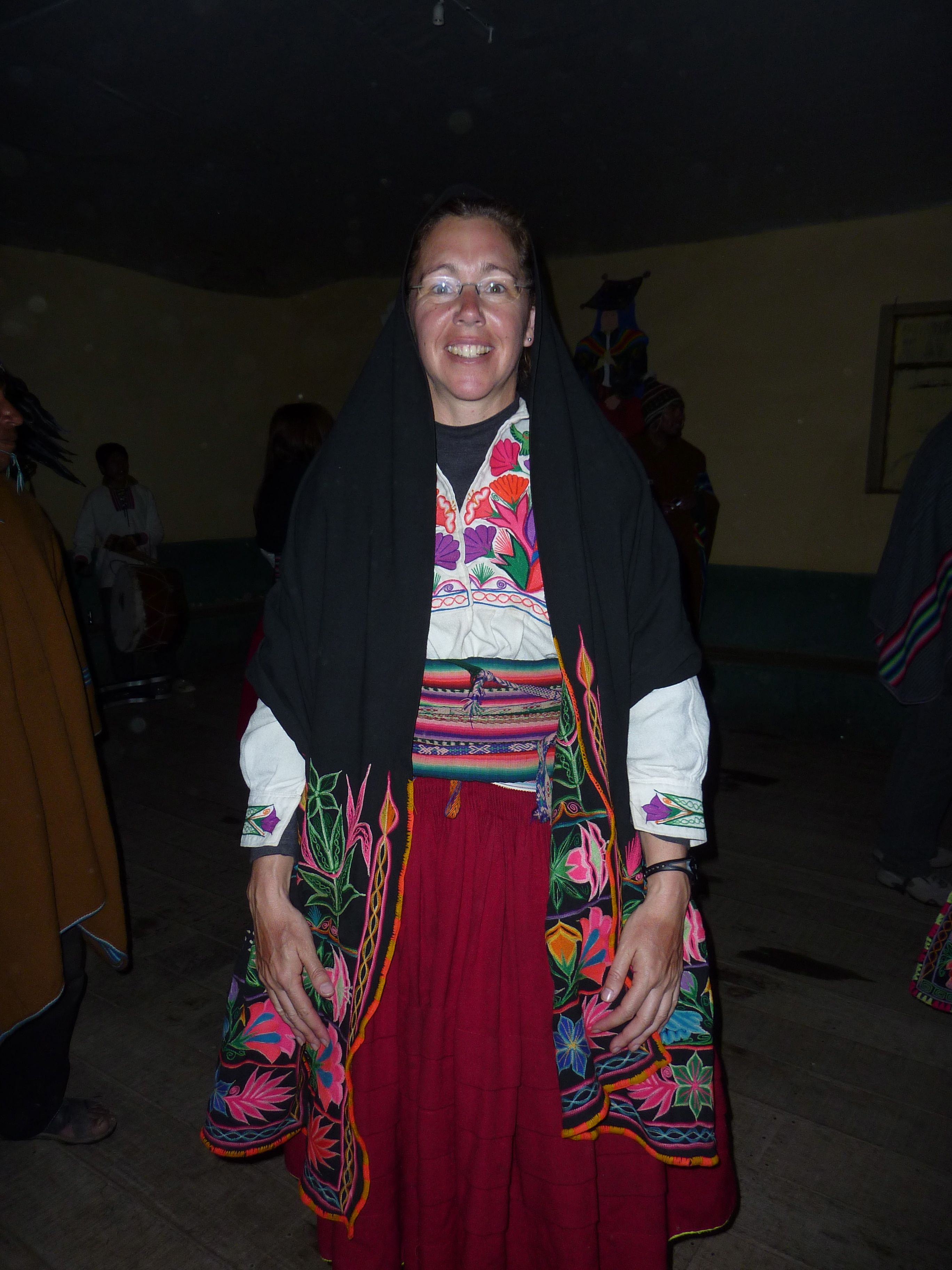
Going native. Me in my native dress, One of the girls with me decided with the black scarf and the glasses, that I looked like a nun....
Two small bands, located at either end of the building took turns playing music for us to dance to. The locals showed us the steps and soon the whole room was full of locals and tourists dancing. They even had a small bar set up where you could by beer! At one point I stepped outside to look at the sky. The moon was out and the storm clouds that had been threatening earlier were getting closer. The sky was beautiful with the clouds reflecting the moonlight and stars shining brightly in the as of yet cloudless part of the sky. I must have sat there for about 30 minutes watching the clouds rolling in enjoying the peacefulness of the scene while hoping that we would be able to get back to the house before the inevitable rain came.
Once the clouds had rolled in enough to hide both the moon and the stars I went back inside for more dancing. After about another hour or so of that our house mama gathered us together and we headed back down the mountain to the house and the indoors. The wind was picking up – the storm was coming. We got to the house, changed, made a last trip to the outhouse, located just through the quinoa crop on the outside of the courtyard walls, and snuggled under our five or so heavy alpaca wool blankets. The beds were very cozy and I was hoping to get through the night without having to go outside and make my way to the outhouse because sure enough, no sooner were we in bed and starting to drop off to sleep then a torrential rain shower started accompanied by strong gusty winds. We were lucky to have made it inside before it started. (I ended up having to get up around 5am but thank goodness by then it was only a drizzle so a trip to the outhouse was not so bad.)

All six of us dressed up in native clothing. It was quite warm and very colorful!
Thus Saturday ended filled with new experiences, new people, new food, new knowledge. Sunday, part two of our trip, will be continued……


Peruvian dance attire! Love it!
I greatly appreciate all the info I’ve read here. I will spread the word about your blog to other people. Cheers.
[url=http://www.autoforextradingsoftware.com]forex trading[/url]